
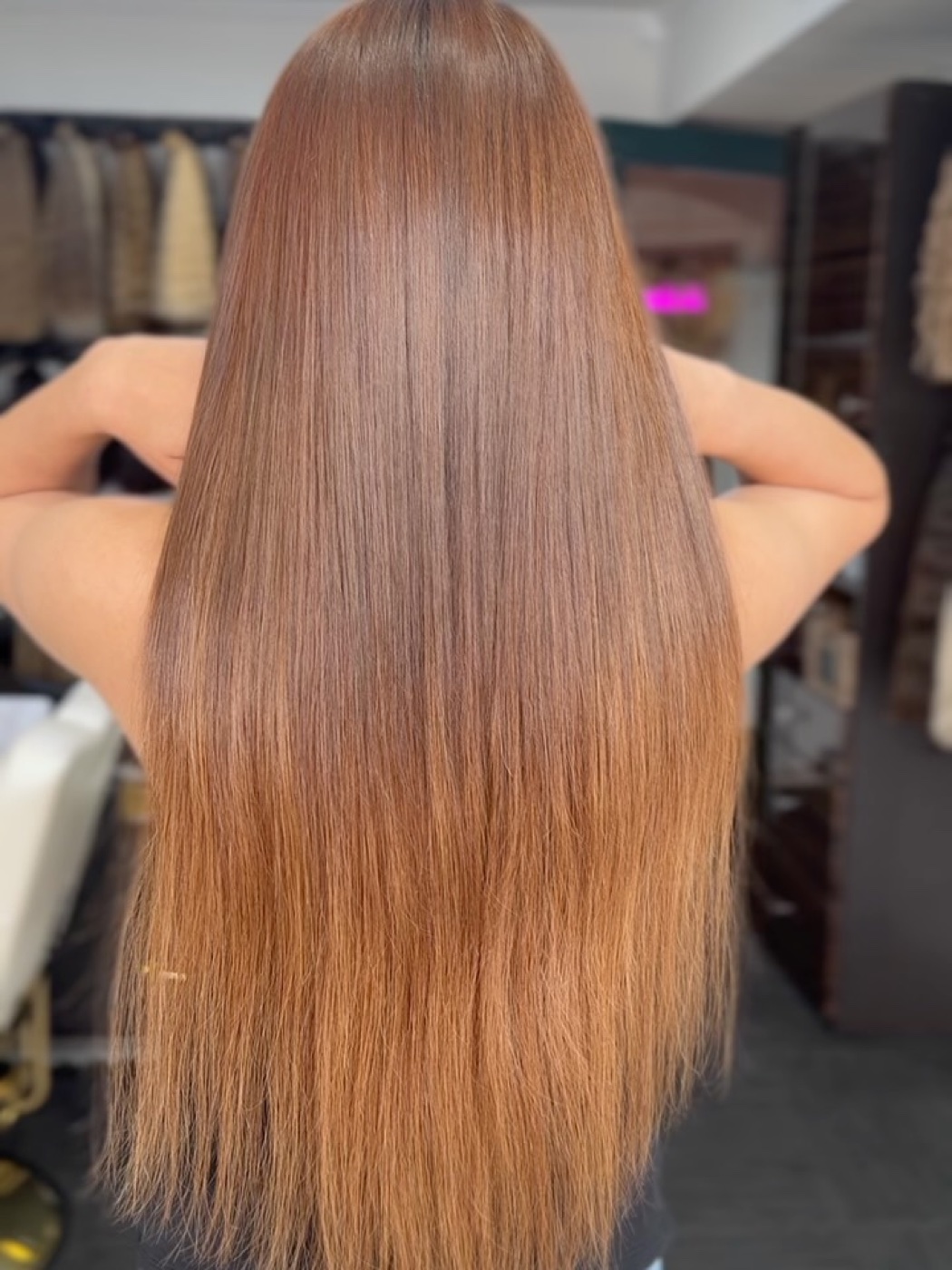
Brown hair is not one color. It is three or four, layered on top of each other, and that is what makes it look alive in daylight. Most people who ask for highlights are really asking for that depth back. This post covers what happens when you lift brown hair, why the result often reads brassy or flat, and how added hair can deliver dimension without a single drop of bleach.
Key Takeaways
- Dark brown hair holds warm pigment that bleach exposes before it removes, which is where orange tones come from
- Tone-on-tone brown highlights sit closer to the base and read more natural than high-contrast blonde
- Color-matched human hair extensions can add dimension and length at the same time, with no lifting of your own hair
Dark brown hair with highlights is the most common request we hear, and almost nobody means the same thing by it. Ask ten people what they mean by natural highlights, and you will get ten different answers. Some want the lighter pieces they had at fourteen. Some want a break in a solid block of color that's gotten heavy. Some just want their hair to stop looking like a wig in photographs.
What almost nobody wants is the part that usually comes with it. That is why so many searches for dark brown with brown highlights end up alongside searches for repair treatments a few months later. The lightening works. The hair pays for it.
We do both in The Woodlands. We highlight hair, and we add hair, and the interesting part of the job is working out which one your hair actually needs. Below is a plain look at how highlights behave on brown hair, what the different shade combinations do, and where added hair solves a problem color alone cannot. Speak to a qualified stylist before booking anything.
What People Mean by Natural Highlights on Brown Hair
Natural highlights for brown hair are not a formula. They describe a result. Hair that has been outside a lot lifts unevenly, lighter around the face and through the top layer, darker underneath where the sun never reached.
Anything that copies that pattern reads as natural. Anything that puts even stripes from root to tip does not, no matter how well it was applied. Placement carries more weight here than the shade itself. That holds whether you want natural highlights on dark brown hair or something softer on a lighter base.
What the eye is actually reading:
- Lighter pieces sitting near the face and the parting
- Depth kept through the back and the under layers
- Soft edges rather than a visible line at the root
- Two or three shades rather than one contrast
Dark Brown With Brown Highlights: Tone on Tone
The safest version of this look keeps everything inside the brown family. A base of dark brown, then pieces lifted two shades, maybe three. Warm caramel, cool mushroom, soft chestnut. The contrast is low, so the grow-out is soft too.
This version suits most people who want highlights on dark brown hair without a maintenance schedule. Lifting two levels does less damage than lifting six. The regrowth line is forgiving, and the color stays wearable for months, not weeks.
What to ask for at the consultation:
- A base shade confirmed under natural light, not salon light
- Lift kept within two or three levels of the base
- Placement weighted toward the front and the top
- A toner plan for when the warmth starts to show
Light Brown Hair Color With Dark Highlights
Running it the other way works too, and it is underrated. Light brown hair color with dark highlights puts depth back into hair that has been lightened so often it has gone flat and one-dimensional. Colorists call these lowlights. The effect is the same idea in reverse.
Most natural highlights for light brown hair work this way in practice, with lowlights doing as much of the job as the lighter pieces. Hair that has lost its shadow looks thinner than it is. Adding darker pieces underneath and through the back gives the eye something to read as volume. It also softens the line between an old highlight and new growth, which buys time between appointments.
Where lowlights earn their place:
- Hair that has been highlighted repeatedly and lost depth
- A grow-out line that needs blurring rather than covering
- Fine hair that photographs flat
- Anyone wanting to step back from full blonde gradually
Blonde Highlights on Brown Hair and Where They Go Wrong
Blonde highlights on brown hair are the most requested and the least forgiving. Brown hair carries warm pigment underneath. Bleach removes color in stages, passing through red, then orange, then yellow, before it reaches anything you could call blonde.
You can't achieve blonde highlights on brown bases in a single appointment, and stopping partway is what produces the brassy result people complain about six weeks later. Pushing through to a clean blonde takes more lift, more time, and more of the hair's structure. Both outcomes are common, and neither is the stylist being careless. It is chemistry.
What to weigh before booking:
- How many levels of lift your hair actually needs
- Whether previous color is still sitting on the lengths
- The toner schedule required to hold the shade
- What condition your ends are in right now
Why Dark Hair Resists Lifting
Natural highlights for dark hair run into a harder version of the same problem. The darker the base, the more pigment there is to remove, and the more of it is warm. Very dark hair can need several sessions spaced weeks apart to land somewhere cool.
Texture matters as well. Fine hair lifts faster and breaks faster. Coarse hair holds its pigment stubbornly and needs longer processing, which is its own risk. When we tell someone their goal needs three appointments rather than one, we're not padding the bill. It is what the hair can take.
Honest limits worth hearing:
- Some shades cannot be reached safely in one sitting
- Previously boxed-dyed hair behaves unpredictably
- Damaged ends lift differently from healthy roots
- A good result sometimes means a smaller change
The Second Route: Color-Matched Extensions
Here is the part most people never hear. Brown color highlights do not have to come from lightening your own hair. They can come from adding hair that is already the shade you want.
We match 100% human hair to your base and the lighter tones you want, then place it the way we would place foils. The dimension is real because the different shades are real, and your own hair is never processed. Sometimes we recommend this instead of lifting. Sometimes we do both in the same appointment, lightening where the hair can take it and adding shade where it cannot.
When we lean this way:
- Hair too fragile to take another lift
- Length and color both on the wish list
- No regrowth line wanted, because there is no regrowth
- A shade you may want to change again later
Matching Extensions to Hair That Is Already Highlighted
If you already have brown highlights on brown hair, matching becomes more involved. One color of added hair against a multi-tonal head reads as a stripe. The match has to account for the base, the lighter pieces, and how the two sit together.
This is where a proper consultation earns its keep. We take the match in daylight, usually with two or three shades blended through the set rather than one. The goal is for nobody to be able to tell where your hair stops. Our hair treatments page walks through what that appointment looks like from start to finish.
What a good match involves:
- Shade taken in natural light at the mid-lengths
- More than one tone blended through the set
- Placement planned around your existing highlight pattern
- A check against how your color fades over time
Fitting Methods That Suit Highlighted Hair
Highlighted hair has been through something, and the fitting method should respect that. Micro bead hair extensions place hair strand by strand with no glue and no heat, which suits hair that has already been chemically treated.
Hand-tied hair extensions spread the weight across a row rather than loading individual strands. They also let us run several tones along the same weft, which is useful when the whole point is dimension. The right method depends on your density, your texture, and where the hair needs to sit.
How the choice usually breaks down:
- Micro bead for precision placement and strand-level control
- Hand-tied wefts for fullness across a wider area
- Both fitted without heat or adhesive
- Method confirmed at consultation, not before
Highlights on Thin or Thinning Hair
Lightening thin hair is a gamble. The strands are already finer, and bleach takes some of what is left. Plenty of people come to us after highlights made their hair look thinner rather than brighter, because dimension without density does not read as fullness.
Extensions for thin hair address the density first, and the color comes along with it. For anyone dealing with gradual loss rather than naturally fine hair, our hair treatments for thinning hair begin with an honest assessment before anything gets fitted.
Why this order matters:
- Density reads as fullness, color reads as dimension
- Fine hair shows breakage sooner than coarse hair
- Added weight has to be planned around what your hair can carry
- Some scalps need a treatment plan before extensions
When Highlights Have Already Done Damage
Over-processed lengths do not repair themselves. Gummy mid-lengths, split ends, breakage at the point where the foil sat, hair that will not hold a curl. These are signs the hair has been lifted past what it could take.
Our damaged hair treatment page starts with an assessment and a straight answer. Sometimes the answer is that a length has to come off before anything else happens. We would rather say that than fit extensions onto hair that cannot hold them.
Signs worth acting on:
- Lengths that feel stretchy when wet
- Breakage at a consistent point along the strand
- Color that washes out within two or three shampoos
- Ends that tangle no matter what you use
Short Hair, Brown Highlights and Placement
Short hair shows highlight placement more plainly than long hair does. There is less length for the eye to travel, so a badly placed piece has nowhere to hide. Done well, the dimension makes a bob look thicker than it is.
Being told your hair is too short for extensions is common and usually wrong. Extensions for short hair come down to fitting skill, not a minimum-length rule. The blend line is the whole job.
What changes with shorter hair:
- Placement has less room for error
- Blending matters more than volume
- Tone differences read stronger at short lengths
- Fitting technique does more of the work
Top Highlights Hair Trends Worth Ignoring
Every season brings a new name for something that already existed. Balayage, babylights, money piece, teasylights. Most of the top highlights hair looks doing the rounds are variations on placement and contrast, dressed up with new vocabulary.
The question that matters is not what a look is called. It is whether the lift it needs is something your hair can survive, and whether you want the upkeep it demands. A stylist who asks about your routine before your reference photos is doing it right.
Better questions than trend names:
- How often are you willing to sit for a toner
- What does your hair look like eight weeks in
- Can your ends take this lift right now
- Is there a version of this that does not need bleach
Making the Color Last Between Appointments
Brown highlights fade warm. That is what brown pigment does as it oxidizes, and no product stops it completely. You can slow it down and stop adding to the damage as it happens.
Heat, sun, and hard water all pull color faster. So does washing every day. Extensions need their own care as well, and a set that is looked after holds its tone far longer than one that is not. Whatever you were given at your appointment, use that rather than whatever is on offer at the drugstore.
Habits that keep the tone honest:
- Wash less often and rinse cooler
- Use the products your stylist matched to your set
- Keep heat tools lower than feels necessary
- Book the toner before the brass arrives, not after
Where to Start in The Woodlands
Brown hair with highlights is one of those goals where the right answer depends entirely on the hair in front of the stylist. The same photo can mean an easy appointment for one person and a bad idea for another.
At ELITE HAIR EXTENSION in The Woodlands, we color hair, and we add hair, which means we have no reason to push you toward one when the other suits you better. Bring the photo. We will tell you plainly whether it is reachable with highlights, with added hair, or with both, and how many visits it will take. If you are planning around a date, we plan wedding hair extensions backward from the day itself. If you are traveling in, our page on hair extensions in The Woodlands, TX covers what to expect. Book a consultation, and we will start with your hair rather than the photo.